The First Financial Bubble
London, Paris and the Netherlands, 1720 — the world’s first international stock-market bubble, when the shares of the South Sea Company, John Law’s Mississippi Company, and a swarm of new Dutch insurance ventures rose and collapsed together within a single year.
In 1720 three financial manias unfolded almost simultaneously. In Paris, John Law’s Mississippi Company (the Compagnie des Indes) drove a speculative frenzy in the rue Quincampoix. In London, the South Sea Company’s scheme to convert the national debt sent its shares — and those of a crowd of imitators — soaring and then crashing, prompting the Bubble Act. In the Dutch Republic, dozens of new windhandel ("wind trade") insurance and shipping companies were floated in a matter of weeks.
With Rik Frehen and Geert Rouwenhorst, I assembled a new database of share prices from all three markets, day by day, through the boom and bust. It lets us watch the bubbles rise and fall in step — evidence that the events of 1720 were a single, connected episode, driven as much by new business fundamentals (Atlantic trade and insurance) as by folly.
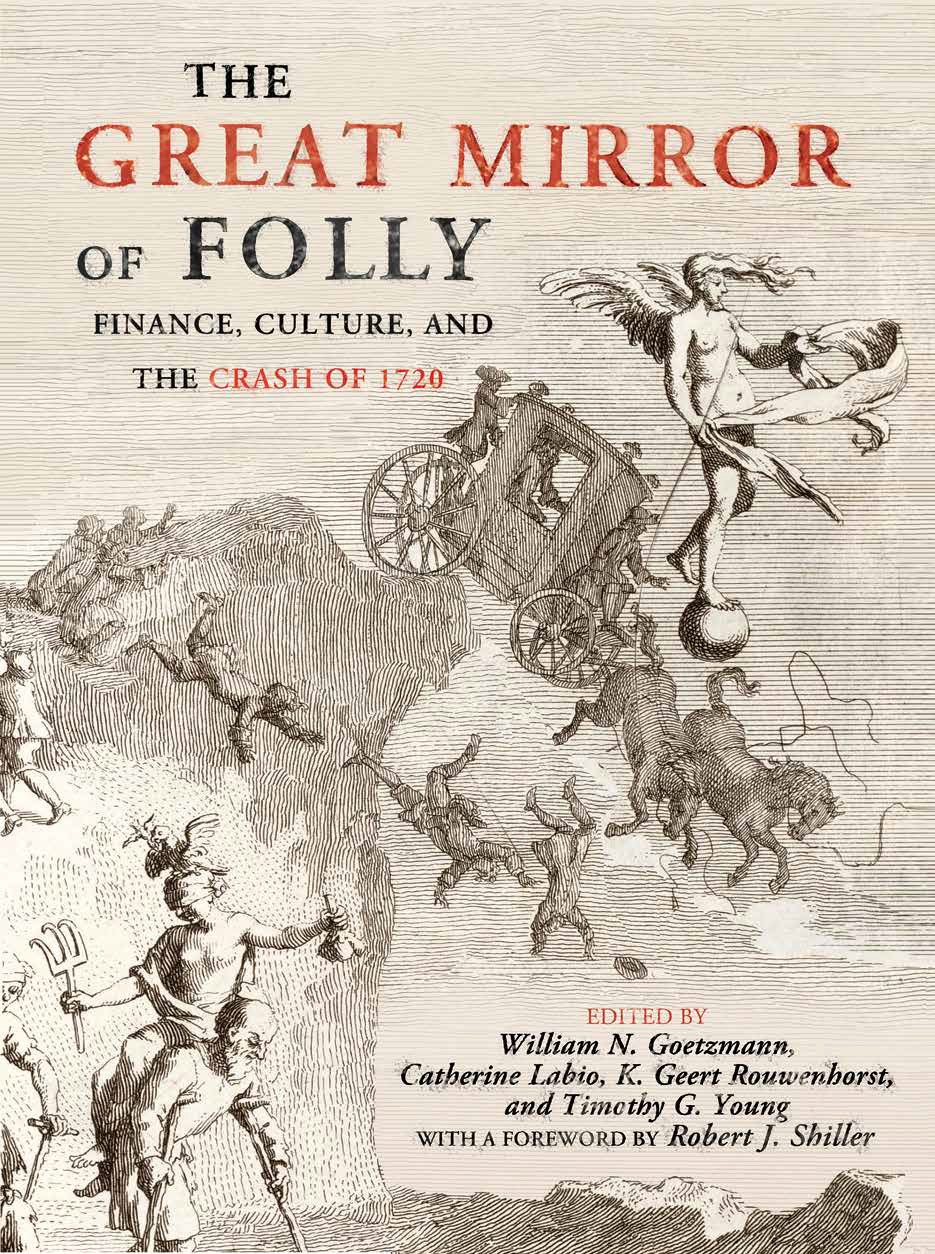
The chart below plots the three markets together; the satirical prints and the Groote Tafereel der Dwaasheid record how contemporaries made sense of it; and the price data are free to download.

Share Prices Across Three Markets, 1719–1720
The Great Mirror of Folly
Each of the three markets left its own satirical record of 1720.



Yale’s Beinecke Rare Book & Manuscript Library holds a remarkable proto-Tafereel — a contemporary collection of the actual pamphlets, prospectuses, and satires as they were issued in 1720, bound together before the famous printed Groote Tafereel was compiled. It is a key source for our work: view it in the Beinecke digital collections →.
Download the data & read the paper
Full 1720 price database (Excel) ↓ Prices (CSV) Series (JSON) Paper on SSRN →Rik G. P. Frehen, William N. Goetzmann & K. Geert Rouwenhorst, “New Evidence on the First Financial Bubble,” Review of Financial Studies / Journal of Financial Economics 108 (2013).